Yesterday night I had a facebook chat with a intelligent friend who reminded me of the the concept of “Known Unknowns” and “Unknown Unknowns”. For example, I know that magazine history is some knowledge I don’t have yet. So is the structure of a magazine. I’m looking forward to get to know more about these topics: These are Known Unknowns.
But I’m really afraid of the knowledge and skills that I should have - because it would make my work so much more easier / relevant / better / [positive adjective] - but don’t know it. This knowledge, of which you don’t even know that you don’t know it, is called Unknown Unknowns. I don’t have many fears in my life, but this is a big one: To miss something out.
I asked this particular intelligent friend what I can do to avoid them. To avoid losing his answer in the dust of facebook comments and messenges, I will copy (and translate) it here:
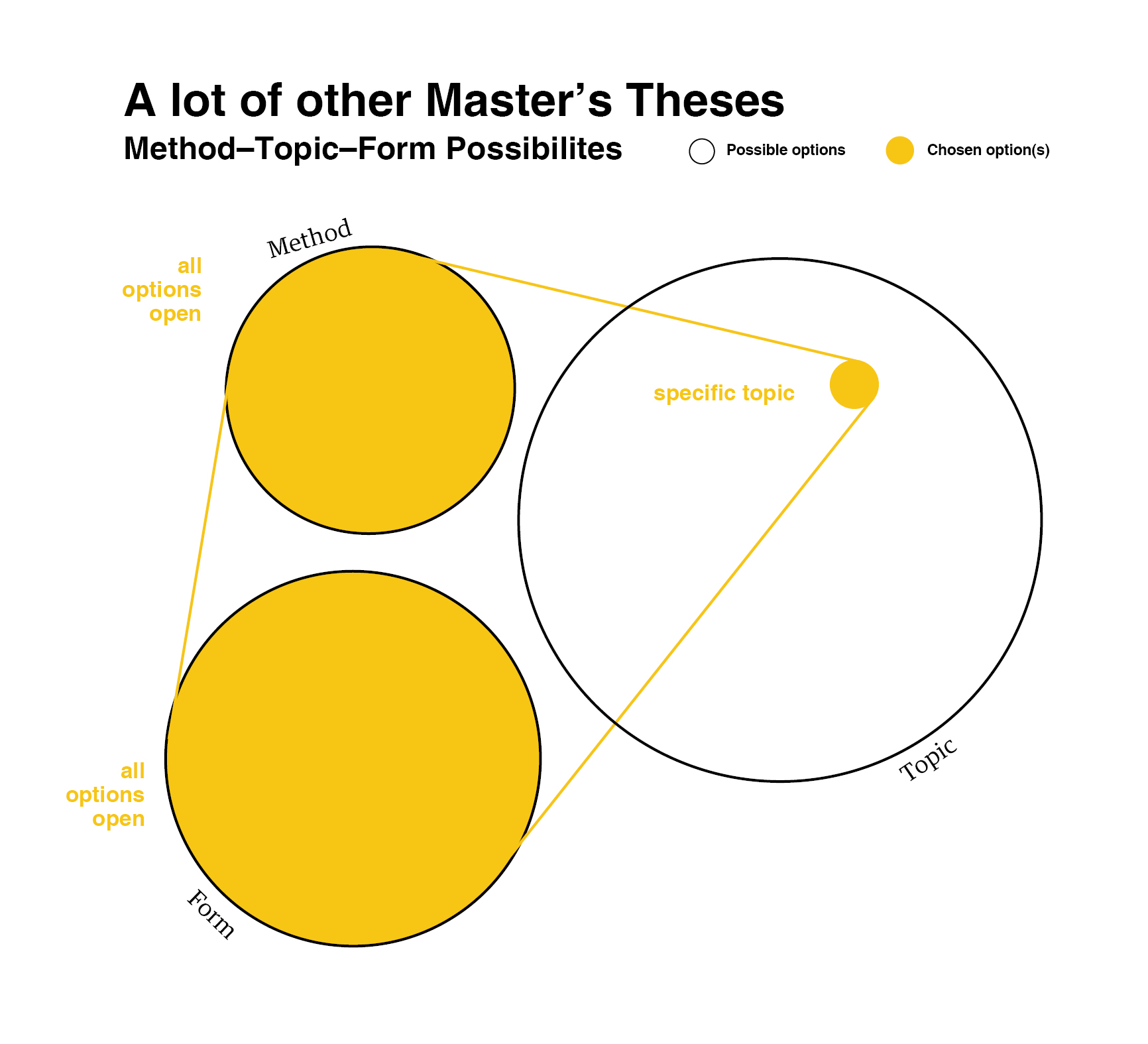
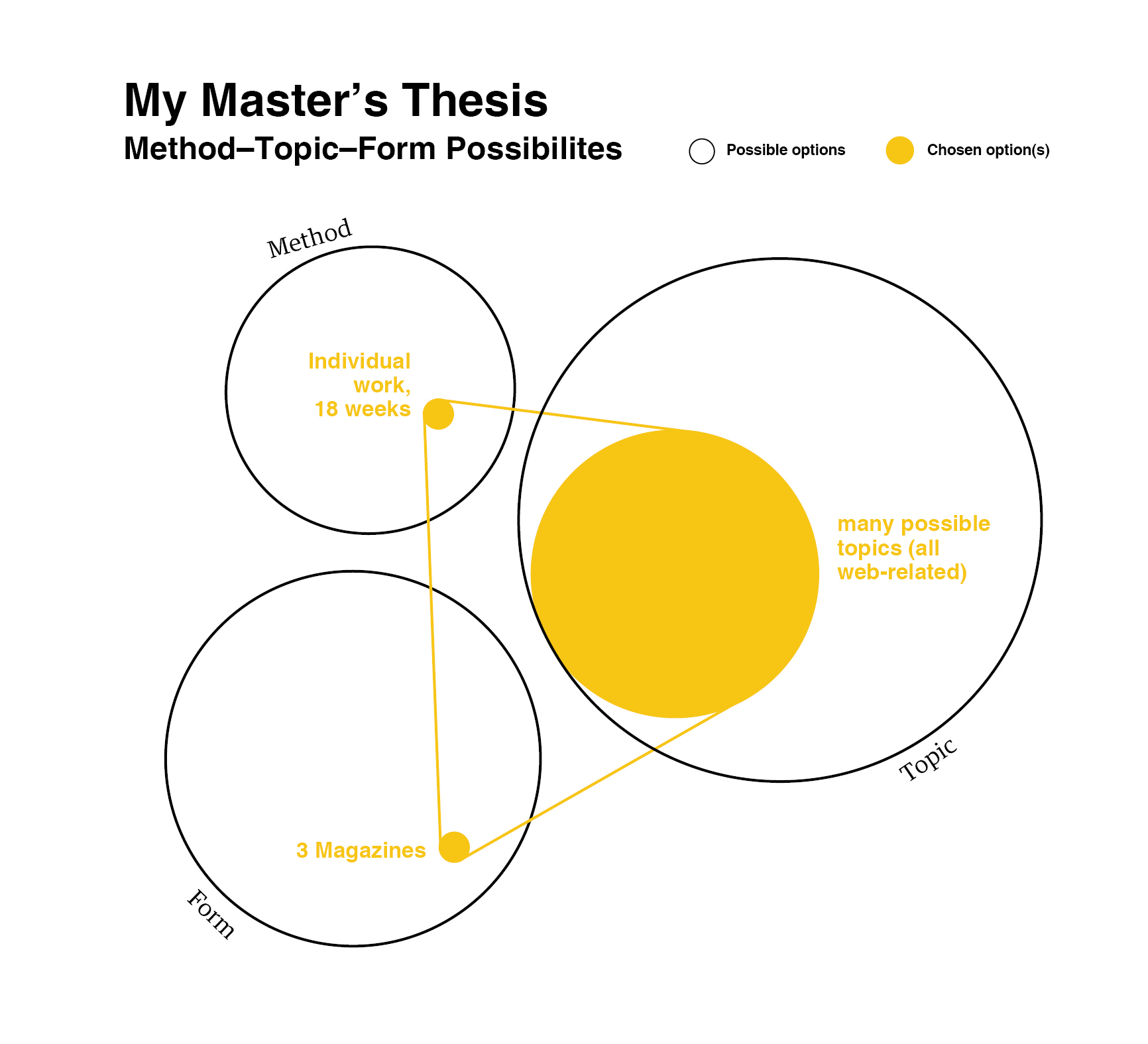
In the hope of finding project-related “Back-Then-Known-But-Now-Unknown Unknowns”, I’ve also looked through some of my old note books. I found the notebook of my time at the School of Design Thinking especially valueable for this - in the three months in 2012 when I was visiting their Basic Track, I was very interested in visual possibilities to get to know myself better and making my work more efficient. I also started to think about my Master’s Thesis during this time. And it was back then that I thought of the concept of Method-Topic-Form Possibilites: these are the three most important parameters I wanted to choose for my Master’s Thesis. So the size of the circles in the image at the top mean the number of possibilites that you can choose from; and the yellow circles refer to the amount of options you chose.
Since I know that I like borders a lot, I’ve always wanted to minimize the yellow color in this graphic. I want my options as limited as possible. (I have a similar opinion about borders in creative projects as Thomas and Martin Poschauko in their book Nea Machina: You should set borders in the beginning to work better, but you can also be open to “back doors”.) This results out of the experience that I’ve never managed to create borders for a graphic design project that were so narrow that I couldn’t create anymore. To the contrary: The more limited the borders, the better I could create.
But interesting enough, I started the other way around: Most graphic design students want to design about a specific topic: Light. Existenalism. Substainability. Whatever. I, however, am pretty sure about the method and form (3 magazines) and am still thinking about the content of my magazine. Sure, the broad topic will be “feedback”. But the sub-topics to treat this topics are at least as important as the topic itself…and still Known Unknowns.
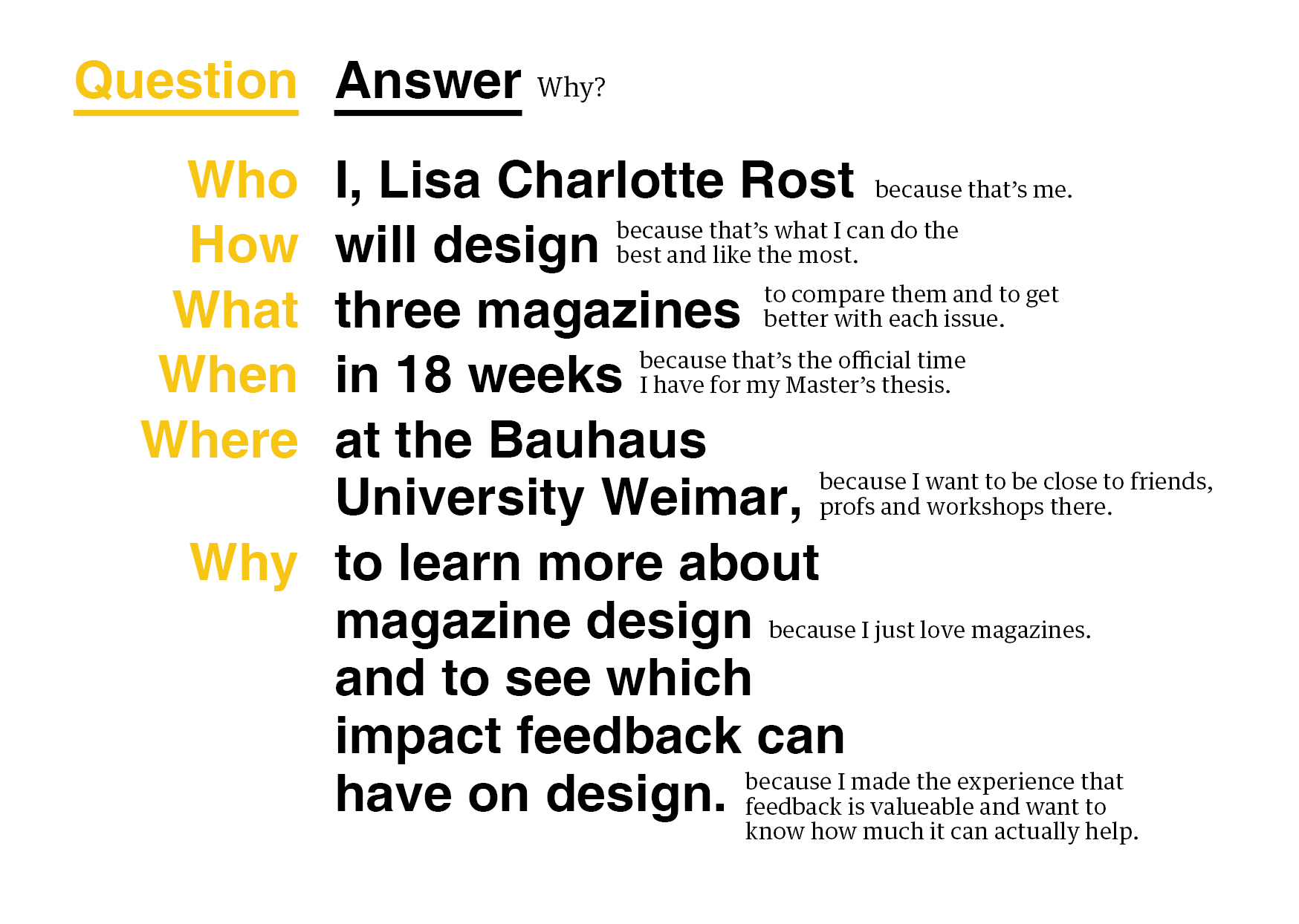
To fight Unknown Unknowns, I’ve also always been a huge fan of asking questions. Questions can’t be asked enough. Especially the Why-Questions. And the Why-of-the-Why-of-the-Why-Question. That’s why I asked “Why?” not only once in the One-Sentence Pitch that can be seen above, but after asking every other question, too. Doing this didn’t teach me so much more - just that at least these questions do not provoke Unknown Unknown. Which is a good sign, I hope. Or do I miss something here?