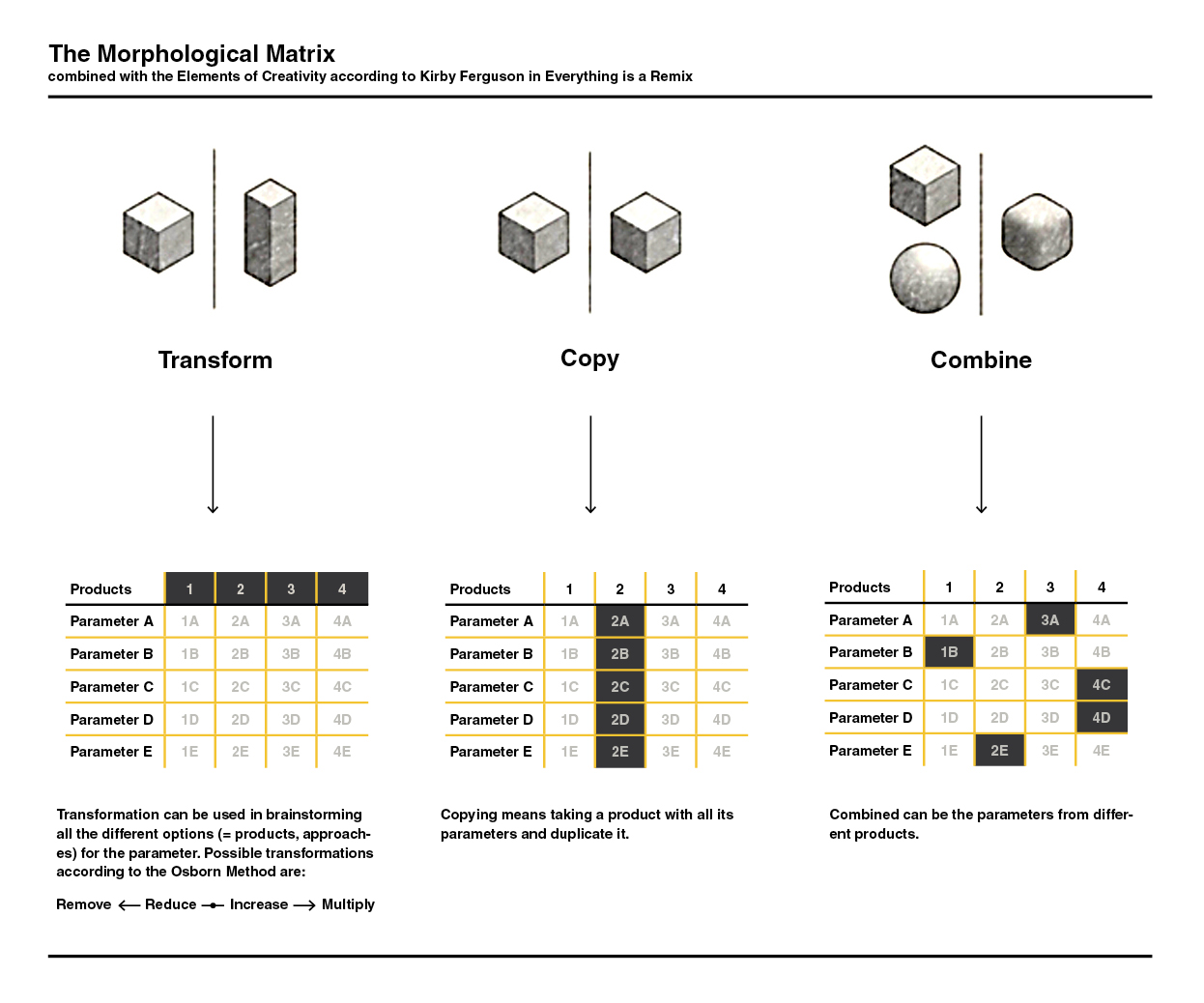
I mentioned it here before: The concept behind the Morphological Matrix. I love this thing. I’m very interested in a lot of creativity techniques like mind mapping, the Osborn Method, the SWOT analysis etc. (not only since my attendance at the School of Design Thinking in Potsdam), but the morphological matrix amazes the most.
You know what amazes, too? The documentation “Everything is a Remix” by Kirby Ferguson. This genius guy mentions three “Elements of Creativity” in his videos - although I doubt he came up with them, because they are so basic. These three elements, the pillars of every invention, are Copy, Transform, and Combine. (You see, I mixed up the order a little bit; but only to make my point.) And I put the original illustrations for these elements from the documentation in my little visualization.
And because I like the Morphological Matrix as a tool for creativity so much, and Fergunsons elements of creativity, I thought we can actually combine both (see what I did here? Combine is the third element of creativity!). The image at the top shows, how: We need the element of transformation to come up with ideas for products / approaches / options (if we’re not using real products, but our mind products). Then we can use the element Copy to learn how a nice combination turns out. (“Imitation is not just the sincerest form of flattery - it’s the sincerest form of learning.” ― George Bernard Shaw.) Or we just take parameters from different products and combine them.
Maybe you wonder: Will such a tool make you a better designer? I doubt that. But it’s an argument for copying, and I like copying. And it shows us how we think, so that we learn to understand it. And maybe in the end - if we understand, what we do, we can extend the doing, too.