Long time no see: In the past few days I enjoyed my life. I went to the pool. I met family and friends. I even bulk-watched TV series.
But my Master’s Thesis is not over yet! I still have to bring the printed book from the bookbinder to the university, and I have to present my work in a few weeks.
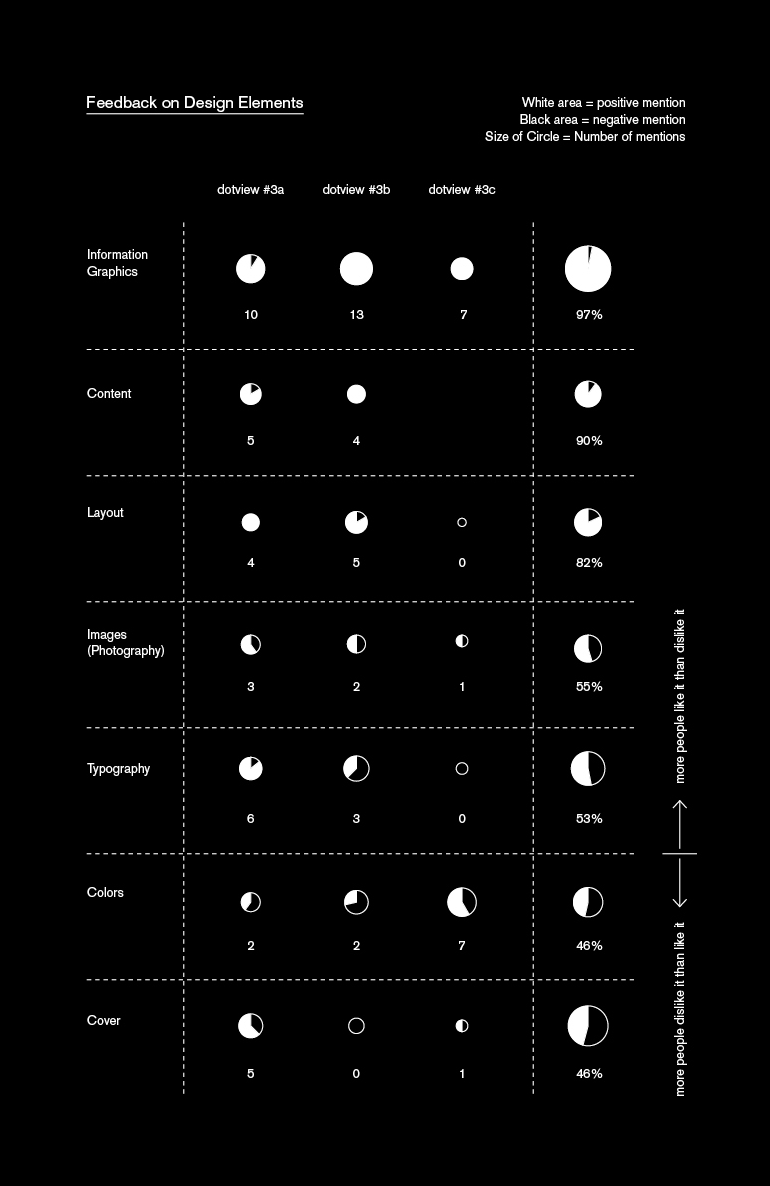
What was one of the main insights I got from my Master’s Thesis so far? I’ll tell ya. On the top you can see how you, the beloved feedbacker, rated different design aspects of my three magazines. What does it show me? Bad things first, my choice of colors and the design of my covers were considered as …bad. The images and typography I chose were also mentioned quite often negatively.
The three most positively mentioned aspects were layout, content of the magazines and information graphics. I see myself as skilled in layout and graphics – but the graphics aspects was mentioned so much more often: Only nine questionees mentioned the layouts positively, but three times so many people talked about how they like the graphics. In all three magazines together there was only one person who disliked them.
That’s interesting. Very interesting indeed. In fact, I’ve tried to strengthen my composition & layout skills for at least seven years now. Information graphics, however, is something I haven’t had any university courses in, not to mention the missing of fellow students or profs who could have helped me with this. It was only a small part of my Bachelor’s Thesis and I had an excellent 3-month internship focused on graphics. Nevertheless, it seems like something that I can do well.
I like that very much. I’ve built my whole Master’s Thesis around magazine design to discover that I’m better in information design. I’ve always thought: “Data Vis / Information design is hard. There are many tools you have to learn to get better. You have to master a lot of numbers. You need to learn programming in order to react to the demand for interactive visualizations.”
Now I think: “Data Vis / Information design is great. There are many tools you can learn to get better. You are allowed to master a lot of numbers. You have a reason to learn programming in order to react to the demand for interactive visualizations.” Because: Actually I like numbers. Why shouldn’t I want to work with them? And the best thing: I like learning. In magazine design, you can learn a lot to get better, but you can’t put your new knowledge in phrases like “I just learned d3.js and Processing.” You can do this with information design. I like that. I like information design.