

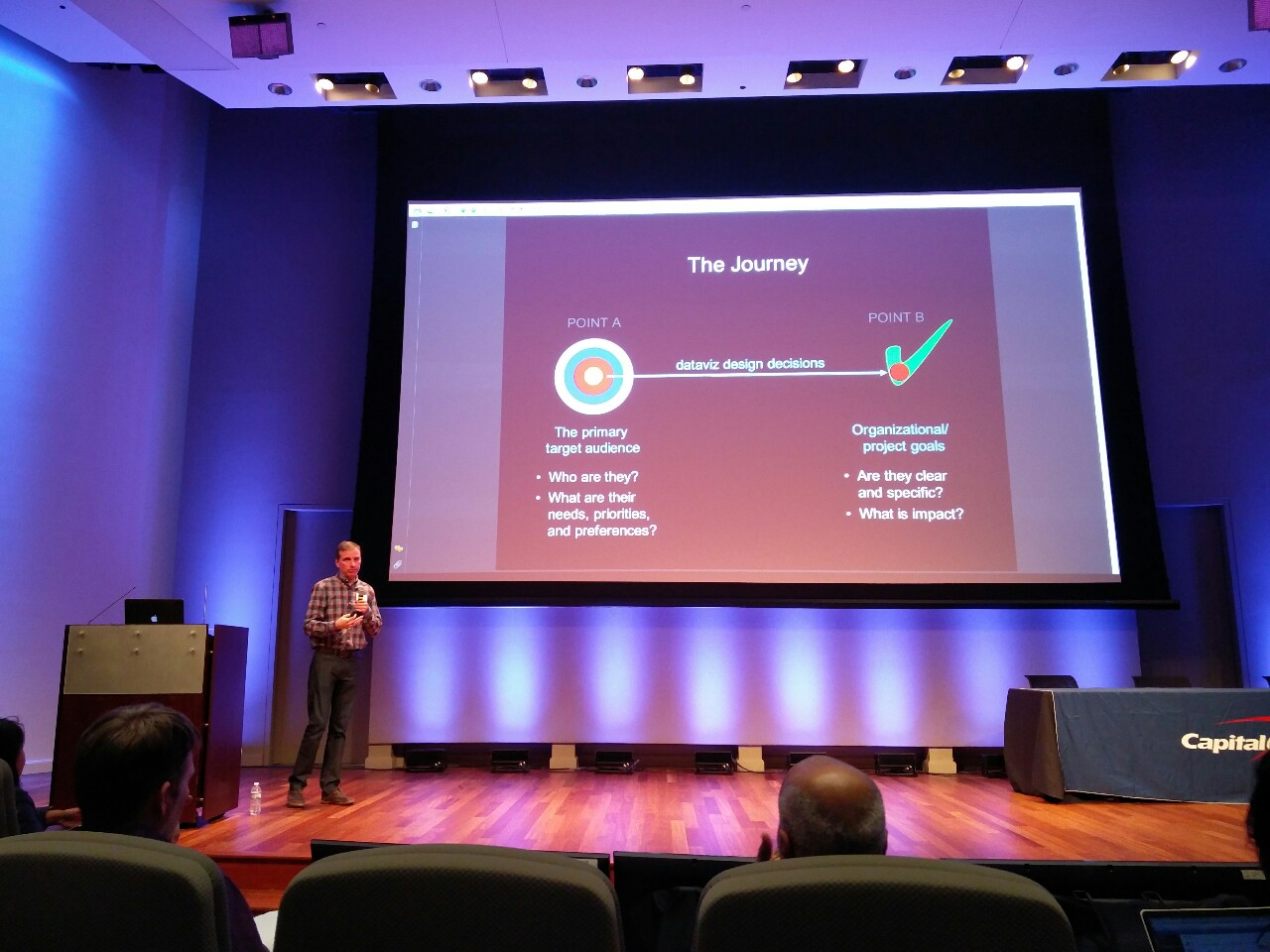
Today was a very good day indeed. I felt like I understand dplyr better than ever before, I applied successfully for a Social Security number, I discovered a neat bike trail, I had a very nice conversation with an old new friend and I went to the Data Vis Meetup DC for the first time.
Although, this particular Data Vis Meetup left me with mixed feelings. Heads-up: I organised the Data Vis Meetup Berlin and this was the first Data Vis Meetup that I attended outside of the one in Berlin.
The Data Vis Meetup DC was obviously very well organised. The venue was extremely far away from the city centre (Virginia. It was in Virginia. It was not even in DC anymore. It was not just another city, it was another STATE. Seriously, why did it need to be so far away?), but well chosen, all four of the lightning talk speakers were great (one of them being Bill Rapp who I mentioned yesterday), the meetup had multiple organisers and sponsors and there even was free food and drinks.
What confused me, however, was the audience and the attitude of the audience. I’ve never attended an event where people looked at my name tag so aggressively more often/longer/earlier than in my face. Most of the attendees apparently scanned the room for the most important people. That was not a “we are passionate about a topic and want to share our passion” thing that I tried to create in Berlin. Instead, it was an efficient networking event, with an older and far more professional audience. I spoke to at least five people, and at some point forced the conversations from the immediately appearing “what are you doing for work?” topic to trivial smalltalk, trying to understand how they are as people and trying to make them laugh. They wanted me as business contacts. I wanted them as friends. (And yes, I made many of my friends in Berlin through the Data Vis Meetup.)
Standing amongst these people before the talks made me feel less interest in the whole field of data vis suddenly. The talks themselves created a healthy balance to that, being not entirely carreer-focused, but also emphasizing ideas like “we can learn from the future” and “let’s try a new visualization form”. So that was good. But yeah, the people, man, the people. I will be at a Data Vis Workshop tomorrow and I’m kind of looking forward to it, but now I’m also kind of afraid to have a similar experience.
Input? 6
Output? 7
Learnings?
I should read more fiction. And autobiographies.
Don’t think about the form before you think about the audience.
“How do you measure impact?” is not a question you can ask in data journalism because you don’t have any goals besides “informing” and “educating”.
Questions?
Is storytelling just linear? Does linear storytelling work best? How to create storytelling which is nonlinear but doesn’t create any FOMO? Maybe one can compare that to singletrack vs. multitrack conferences. I don’t like multitrack conferences. They make me feel like I’m missing out, constantly. And that’s how I feel in a nonlinear story: Like I’m not going the best possible path. And I’m upset about the creator because it feels like she or he WOULD have been able to decide what the best possible path was, but didn’t.