So! The first “Arbeitsgruppe Abschlussklasse” (“Task Force Graduation Class”) happened yesterday and I was nothing but surprised. Let me explain you why.
What was the purpose of organising it? We (five design students) started the Arbeitsgruppe Abschlussklasse to finally get good feedback. In university courses one notices that feedback is rare: Not because of missing good thoughts in the brains of the students, but because of the peer pressure. I’ve never been an exception to this, sadly. The Arbeitsgruppe Abschlussklasse circle should be small, so the not-so-dumb but shy people like I can flourish. Although we want this meetup to be among friends, we force ourselves to establish a certain formality; realised in formal presentations and moderated discussions for example. That was important for me: Personally, I also want to use the Arbeitsgruppe Abschlussklasse to improve my presentation and discussion skills.
The concept is the following: Everybody has 30 minutes time and can “use” the audience as he or she likes. It’s possible to just present something in half an hour. Or to present something in five minutes and then ask for feedback in the other 25 minutes. Or to think about a problem together with the group the whole 30 minutes. Or to do a 30 minutes workshop with them. The possibilites are infinite.
I thought the Arbeitsgruppe Abschlussklasse would be a nice idea, but it was surprised about how great it actually was. Three things surprised me the most:
1. Great feedback: In the first “Arbeitsgruppe Abschlussklasse” we were five people with four presentations. We see each other almost every day for lunch where we talk about our work as well - and I was not sure how much a formal presentation and discussion of our work could differ from lunch meetings. But it differed a lot! The depth of discussion was…deep; not just I got vey helpful feedback from my peers. I’ve heard ideas from my friends about my work that I’ve never heard before and got great ideas for inspiration.
2. Great number of people: The size of five people was surprisingly perfect. Before the meetup, I was certain that five people couldn’t be enough. More people means more feedback, I thought. But I didn’t consider that small, intimate group mean also more openness in speech, more honesty and less pressure to say something smart. And that actually made a huge difference. Everybody was constantly focussed in the discussion, because everybody thought about how she or he could build on the argument of the neighbor. Small groups, I tell ya; that’s the golden way to good feedback.
3. Great presentations: I like to present because I can improve my presentation skills and can build a nice PDF. The latter one is just a lot of fun to me, but also forces me to sort my thoughts and my process. Presenting is - not only for the audience, but especially for me - an overview over what I’ve done so far and a checking if everything makes sense. I knew this before - but it just surprises me everytime again how helpful preparing a presentation really is. What I underestimated even more was the utility of the other presentations. All five of us have very different topics to deal with (substainability, service design, photography books, magazine design (that’s me!) and exhibition design), but I was surprised of how interesting it was when my peers explained methods they used - and how easily I can transfer these methods to my own projects. Explaining the methods I use is definitely something I want to do in the next meeting of the Arbeitsgruppe Abschlussklasse.
So to sum it up: The first meetup of the Arbeitsgruppe Abschlussklasse was a surprisingly great success in terms of the quality of presentations and feedbacks as well as the size of the group.
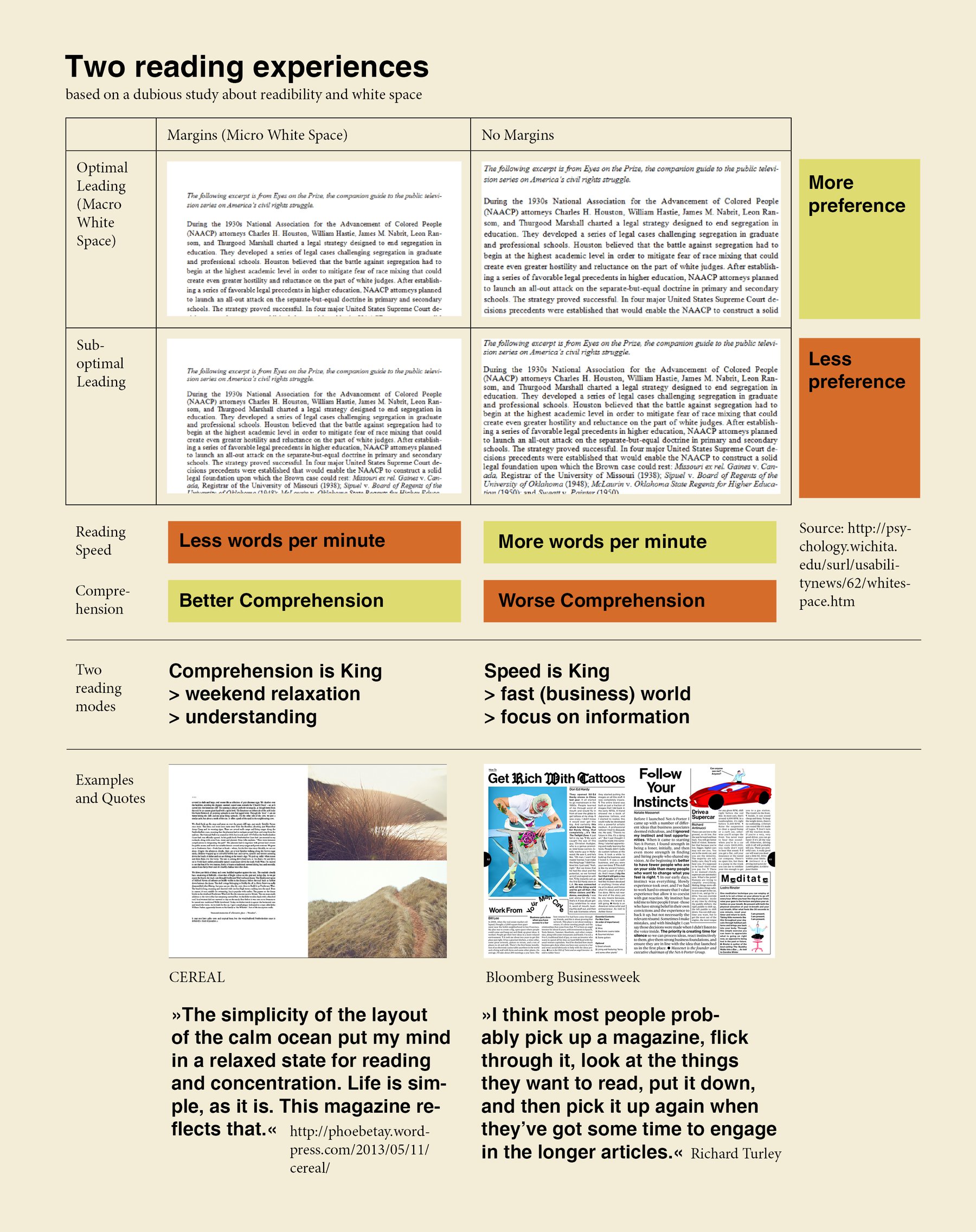
What I presented yesterday? I spoke about not-whitespace (which I have in my current issue) and white space (which I will have a lot in the next issue) and explained - based on a dubious study I found - which reading modes they trigger. As an explanation for these two reading experiences I used the CEREAL-magazine with it’s very minimalistic and the Bloomberg Businessweek with it’s often very clustered design. The conclusion of my presentation: If you want to bring the reader in a very relaxed mode in which the focus is on understanding and comprehension, then use a lot of white space. If you want to communicate the reader a lot of information fast, then use still optimal leading (macro white space), but not so much white space in between bigger elements (like margins; micro white space).