International Journalism Festival, Perugia, day 4! Not so good weather, really good talks. I always wonder how much the perceived quality of the talks depends from…me. Do I write off some talks too early? Do I just don’t listen properly? Well, anyway - today the perceived quality of the talks and panels I went to was high.
And besides them, I had lunch with Ana and Dinner with lots of women in technology from Berlin. Ana is a journalist from France who writes articles for an extreme niche. I took away two important points:
1) I was excited about how much sense it made what she was doing: She basically writes about one field only, and the people who read her news are at the same time the people she writes about. She saves her readers a lot of time: She goes to conferences, meets with people and finds out about all the new stuff in the field. Meaning, her readers get all the new knowledge about the field in one package - they don’t need to find all the new stuff themselves. The important thing here is that yes, they would look for that knowledge themselves if Ana wouldn’t present it to them on a silver plate, because yes, her readers need to know this information for their job. They’re acting upon that knowledge. Ana’s reader are forming the news Ana is writing about. I feel like that’s how journalism started (= informing people about job-related or location-related news), and that’s still my favourite kind of journalism. I really like reading news about the field of data visualisation, because I feel like I’m IN the field and can change it.
Maybe I should feel the same about news about the world (that I’m IN the world and that I can change it), but I feel overwhelmed instead. I sense that huge gap between the audience on the one hand, and the people/organisations that the news report on. The people the news report on are NOT the audience. The people and organisations in the news have power, they are in charge of governments or companies. It feels like a “They” against a “We”.
2) As a journalist, you’re never really independent. There’s always somebody who gives you money. Well, we tend to think that advertisement and sponsored newspapers/events are bad, because we think that journalists wouldn’t write negative things about their sponsors. But Ana pointed out that she can’t write freely about her field, because her readers are the reported subjects AND her subscribers at the same time. I’ve never thought about that.
Input? 9
Output? 1
Learnings?
Don’t say “better” or “worse” or “more” or “less”. The question is always: “by how much?”
Sometimes you don’t have to compare your data to the ideal data, but to the alternative option. Eg BMI, it’s better than nothing.
It’s easy to lie with statistics, but it’s even easier to lie without statistics.
It’s important to let people know that and what we, the journalists, don’t know yet in an article.
If you explain your (startup) idea and everybody is nodding in agreement, your idea comes too late. But you can also be too early - so you want to hit the sweet spot.
You might be right about your big mission; your 10-year-goal. But there are many different ways to get there, and you’re probably wrong about the best possible 1-year-goal.
Buzzfeed is doing “identity-establishing” journalism: If we share an “28 things only xxx can know” article on Facebook, we make clear where we belong.
Buzzfeed makes funny stuff to finance their serious journalism. Questions?
You can have the exactly right answer to the wrong questions. So what are the right questions?
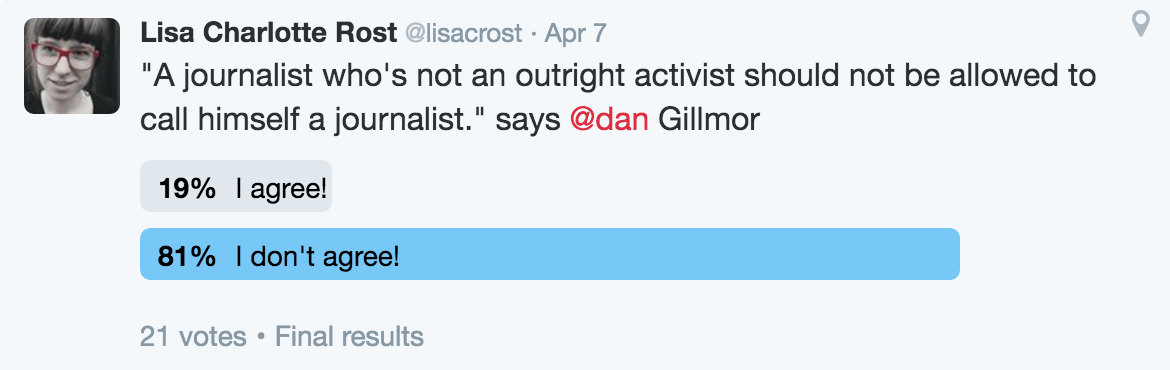
Are journalists activists? Is it more efficient to be a journalist than an activist? Is it a reasonable thing to DON’T make clear that you have a clear stance when you’re writing an article about a topic where you would love to see some change? Is it a good idea to let the readers figure out themselves what and how they should change it?