Resonate, Belgrade, day 4 - good day today! I went to lots of talks, I met Nicolas Felton, Julian Burgess and Erik Boertjes, and had great conversations with them. I saw two themes today (yes, that’s me building a narrative):
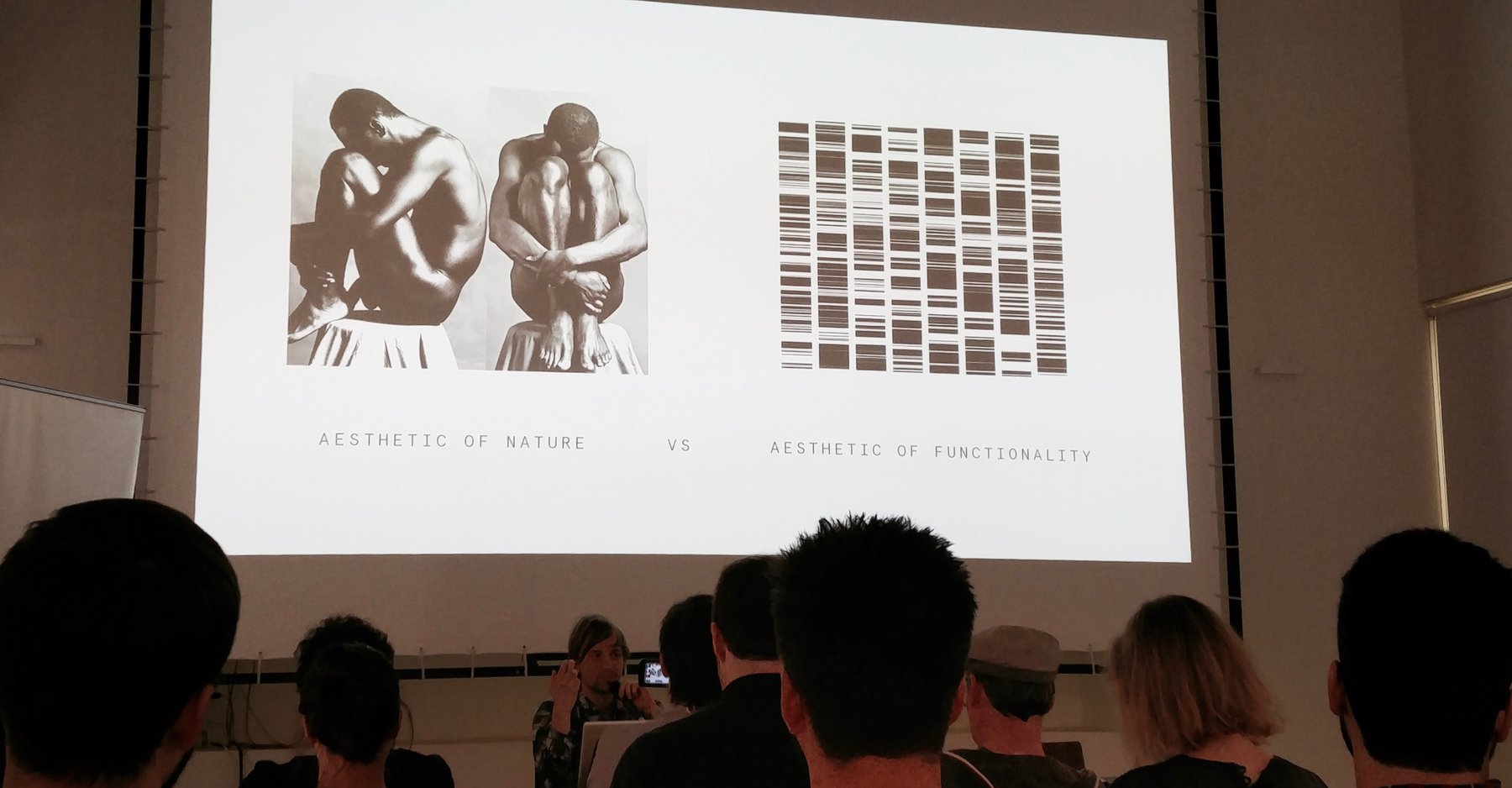
The first one was “chaos is ok”. I’ve heart things like “Maybe being in an uneasy place is an ok place to be at home.” and “It’s important that we understand that chaos is the reality. Rococo churches are the American dream, the abstractions, the perfection. The world is not perfect.” and “I’m coming back to the concept of wabi sabi”.
And because the chaotic “reality” needs to embraces, the conclusion is that abstraction needs to make sense. I very much liked Joshua Noble’s talk, who quoted Alexander Stepanov: “I still believe in abstraction, but now I know that one ends with abstraction, not starts with it. I learned that one has to adapt abstractions to reality and not the other way around.”
Also related to that, I had a discussion with Raphaël which resulted in the analogy between journalistic articles and maps. Journalists (like many other professions) build maps for the world: They take “reality” (the territory) and remove everything that’s not important for navigating in reality, aka for using the map. So the question is: What do you need to USE it for? (Here we’re coming back to the idea that Journalism should help building useful beliefs!) With which goals are we drawing the map? For who and why are we drawing the map? Do we want to give people an overview? Do we want to help them navigating to a specific goal? Do we want to get their attention with an exciting design? And when we defined the goal: What do we, as map-makers aka journalists, need to emphasize on this map so that it is useful?
Also, as a data vis person I liked a project Joshua was showing: He created an ankle bracelet that produced a subtle electro shock every time you went into an area with a higher or lower median income than you had. I found the idea of relating data to individuals in a tactile way amazing, although I believe there are even more interesting use cases for that than the one Joshua presented.
Input? 8
Output? 3
Learnings?
Successes point into the past. Failures point towards the future.
It seems to be common practise in the media art scene to put a lot of effort into the concept of a piece and then to not explain this concept to the audience. As a result, the audience sees an arbitrary aesthetics and can’t make sense out of it - although there is lots of sense in it.
We do not see things as they are, we see them as we are.
Questions?
Is comprehensive and comprehendible a trade off? How comprehensive does a story need to be?