Today I read my one favourite book about “models and diagrams to visualize yourself and your world and therefore improve yourself” - “50 Erfolgsmodelle” - and two similar, but not as good ones (“Die Welt erklärt in drei Strichen” und “Das Buch der Diagramme”). I did it not with a specific purpose (which was a mistake, maybe), but just to remind me of the popular models and how they can help me in the time of my Master Thesis. However, I not just copied the models, but tried to think a little bit more about them.
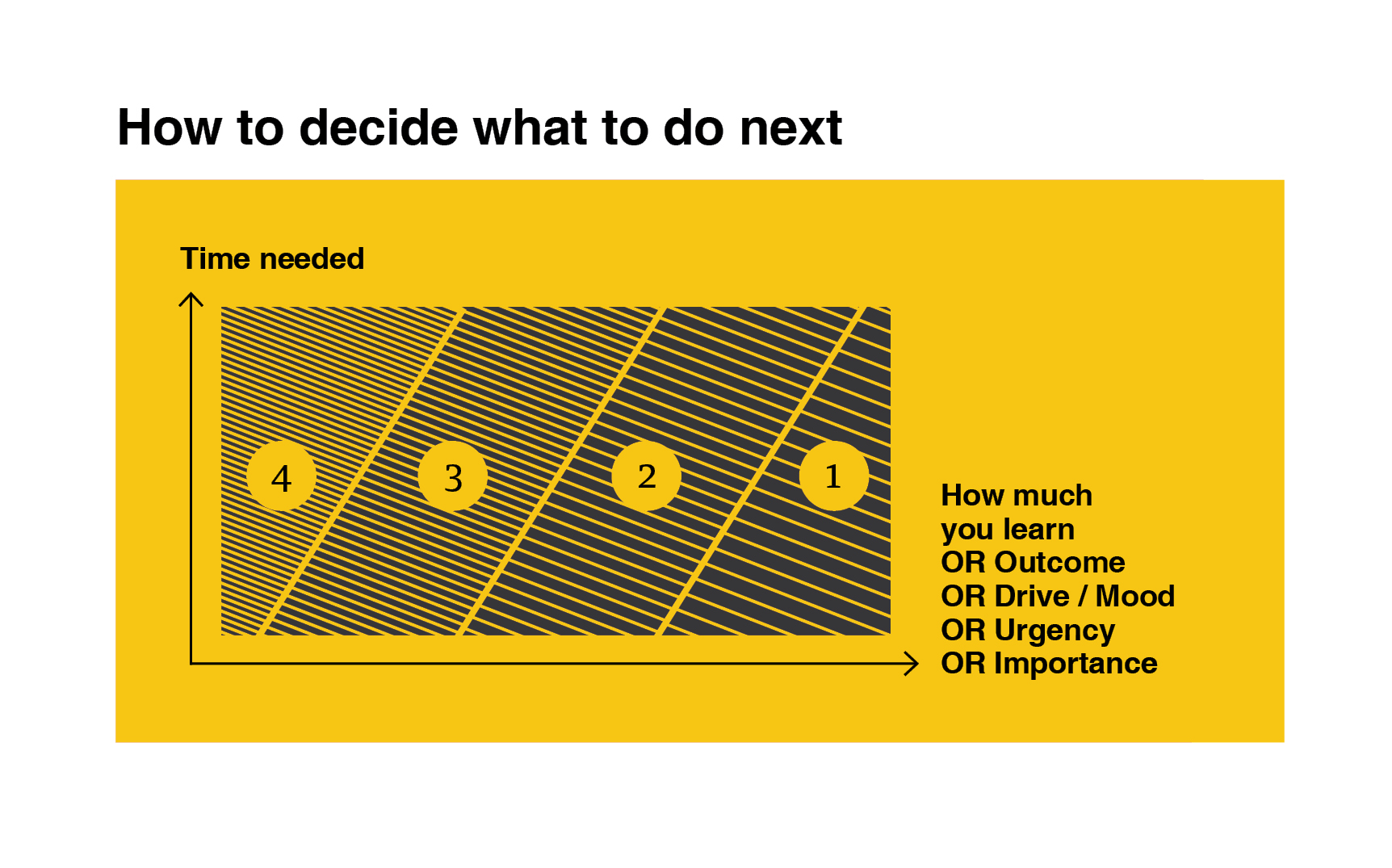
The model at the top, for example, shows the order of priorities in which you should work at your tasks. The less time you need to finish a task and the more you gain out of it or the more urgent or important it it or the more you like to do it; the higher should it be on your priority list of to dos. I even think - and I tried to visualise it - that something not so urgent or important should be done first if it takes significant less time to do it.
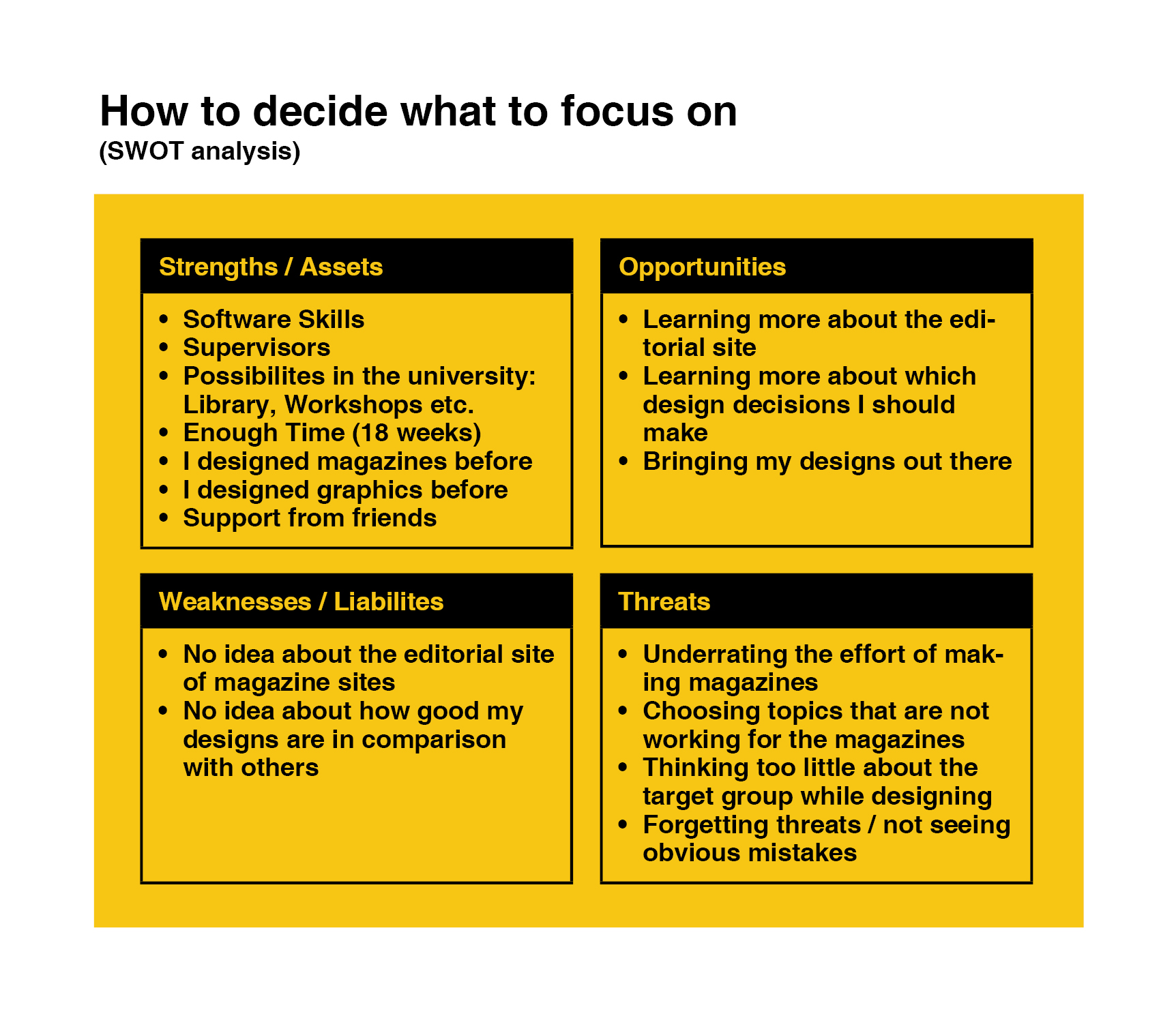
The second model is the SWOT analysis. I put my own strengths, weaknesses and possible oppurtunities and threats in it. While doing this, I noticed how dangerous such an analysis can be: It forces you to see a problem, idea or action from another point of view, which is great, but it does not necessarily asks you what to do this with this new view on things. Related to the SWOT analysis, it’s nice to see this overview - but it’s also very important that I go the next step and ask myself: How can I focus more on my strengths, how can I compensate my weaknesses? (Here I’m lucky, because all my weaknesses turn out as oppurtunities to learn something.) And how can I prepare myself for the threats?
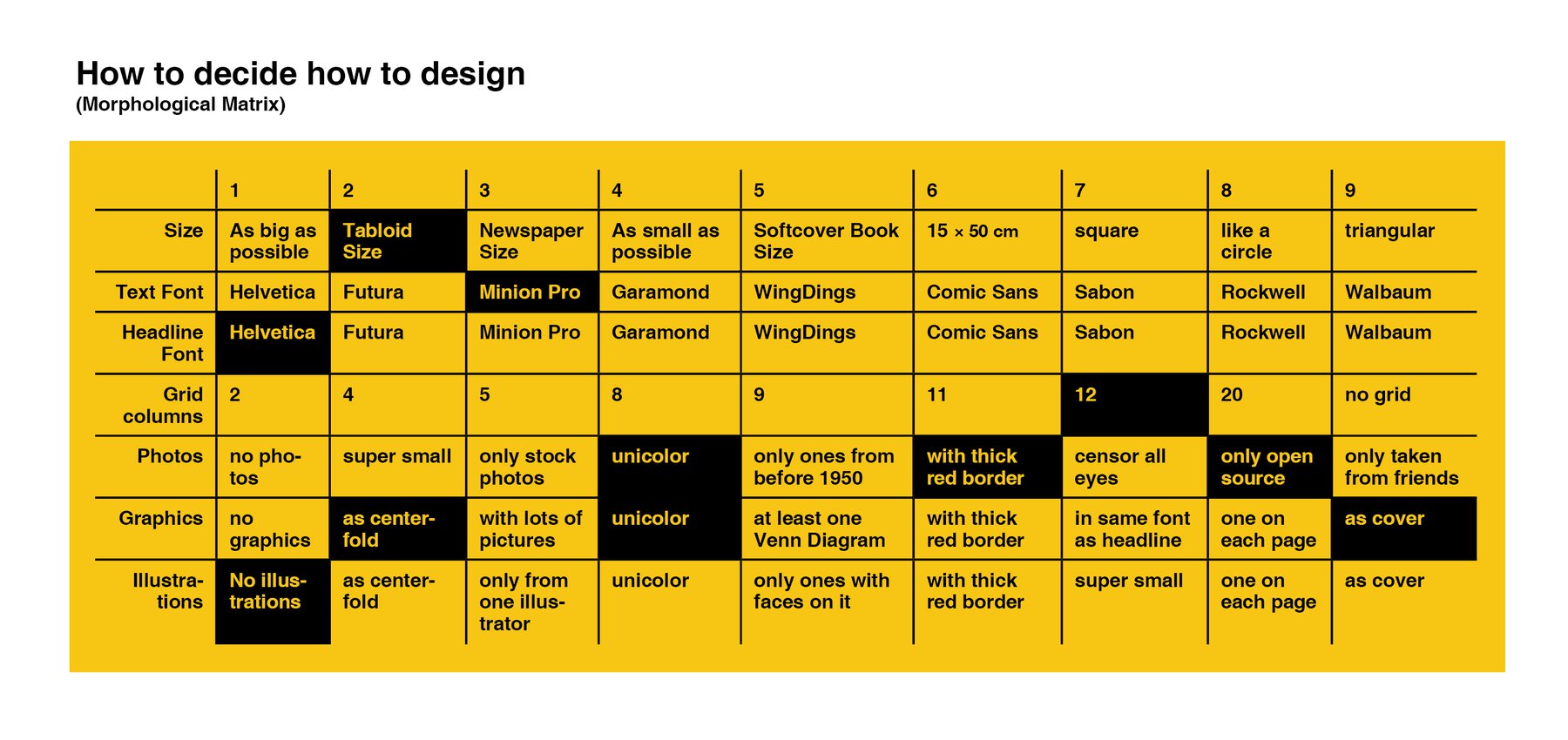
The last model is a Morphological Matrix. I like this kind of analysis, because it demonstrates so simply that a lot of creativity is just the re-combination of known things (see “Everything is a Remix”, a great series, to get the prove). Normally, you write down a lot of possible options for a specific parameter in a row and then choose one of them. But in terms of graphic design and depending on the chosen parameter it’s of course possible to choose more than one option per row. For example, the photos in my magazine will be unicolor with a thick red border and only from open sources. Even if my parameter would be “sources for photos”, I could choose more than one option, e.g. “stock photos” and “open sources”.
Maybe the best thing about the Morphological Matrix is that it forces you to think about options for your parameter. Especially if the parameter are very specific like “size”, “grid columns”, “photo sources”, “text highlight possibilities”, you often have to think a little bit more after writing down the usual four, five options. Maybe it’s worth to do a little brainstorming about the parameter first.